
Text Below:
Context
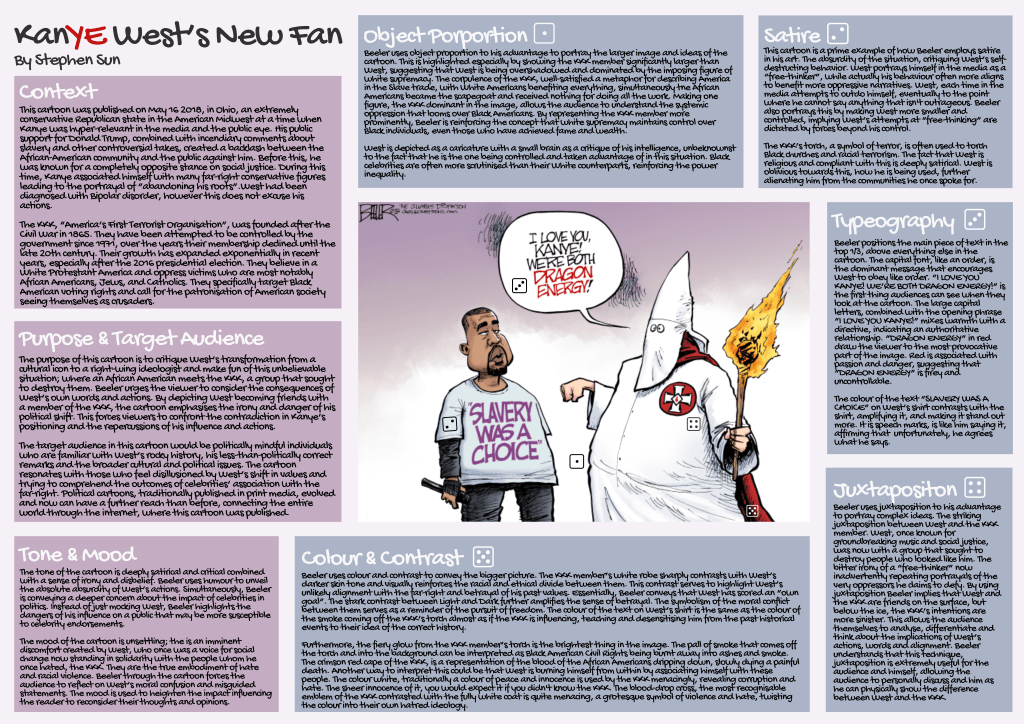
This cartoon was published on May 16 2018, in Ohio, an extremely conservative Republican state in the American Midwest at a time when Kanye was hyper-relevant in the media and the public eye. His public support for Donald Trump, combined with incendiary comments about slavery and other controversial takes, created a backlash between the African-American community and the public against him. Before this, he was known for a completely opposite stance on social justice. During this time, Kanye associated himself with many far-right conservative figures leading to the portrayal of “abandoning his roots”.West had been diagnosed with Bipolar disorder, however this does not excuse his actions.
The KKK, “America’s First Terrorist Organisation”, was founded after the Civil War in 1865. They have been attempted to be controlled by the government since 1971, over the years their membership declined until the late 20th century. Their growth has expanded exponentially in recent years, especially after the 2016 presidential election. They believe in a White Protestant America and oppress victims who are most notably African Americans, Jews, and Catholics. They specifically target Black American voting rights and call for the patronisation of American society seeing themselves as crusaders.
Purpose & Target Audience
The purpose of this cartoon is to critique West’s transformation from a cultural icon to a right-wing ideologist and make fun of this unbelievable situation; where an African American meets the KKK, a group that sought to destroy them. Beeler urges the viewer to consider the consequences of West’s own words and actions. By depicting West becoming friends with a member of the KKK, the cartoon emphasises the irony and danger of his political shift. This forces viewers to confront the contradiction in Kanye’s positioning and the repercussions of his influence and actions.
The target audience in this cartoon would be politically mindful individuals who are familiar with West’s rocky history, his less-than-politically correct remarks and the broader cultural and political issues. The cartoon resonates with those who feel disillusioned by West’s shift in values and trying to comprehend the outcomes of celebrities’ association with the far-right. Political cartoons, traditionally published in print media, evolved and now can have a further reach than before, connecting the entire world through the internet, where this cartoon was published.
Object Porportion
Beeler uses object proportion to his advantage to portray the larger image and ideas of the cartoon. This is highlighted especially by showing the KKK member significantly larger than West, suggesting that West is being overshadowed and dominated by the imposing figure of white supremacy. The corpulence of the KKK, well-satisfied a metaphor for describing America in the Slave trade, with White Americans benefiting everything, simultaneously tne African Americans became the scapegoat and received nothing for doing all the work. Making one figure, the KKK dominant in the image, allows the audience to understand the systemic oppression that looms over Black Americans. By representing the KKK member more prominently, Beeler is reinforcing the concept that white supremacy maintains control over Black individuals, even those who have achieved fame and wealth.
West is depicted as a caricature with a small brain as a critique of his intelligence, unbeknownst to the fact that he is the one being controlled and taken advantage of in this situation. Black celebrities are often more scrutinised than their White counterparts, reinforcing the power inequality.
Satire
This cartoon is a prime example of how Beeler employs satire in his art. The absurdity of the situation, critiquing West’s self-destructing behavior. West portrays himself in the media as a “free-thinker”, while actually his behaviour often more aligns to benefit more oppressive narratives. West, each time in the media attempts to outdo himself, eventually to the point where he cannot say anything that isn’t outrageous. Beeler also portrays this by making West more smaller and controlled, implying West’s attempts at “free-thinking” are dictated by forces beyond his control.
The KKK’s torch, a symbol of terror, is often used to torch Black churches and racial terrorism. The fact that West is religious and compliant with this is deeply satirical. West is oblivious towards this, how he is being used, further alienating him from the communities he once spoke for.
Juxtapositon
Beeler uses juxtaposition to his advantage to portray complex ideas. The striking juxtaposition between West and the KKK member. West, once known for groundbreaking music and social justice, was now with a group that sought to destroy people who looked like him. The bitter irony of a “free-thinker” now inadvertently repeating portrayals of the very oppressors he claims to defy. By using juxtaposition Beeler implies that West and the KKK are friends on the surface, but below the ice, the KKK’s intentions are more sinister. This allows the audience themselves to analyse, differentiate and think about the implications of West’s actions, words and alignment. Beeler understands that this technique, juxtaposition is extremely useful for the audience and himself, allowing the audience to personally discuss and him as he can physically show the difference between West and the KKK.
Typeography
Beeler positions the main piece of text in the top 1/3, above everything else in the cartoon. The capital font, like an order, is the dominant message that encourages West to obey like order. “I LOVE YOU KANYE! WE’RE BOTH DRAGON ENERGY!” is the first thing audiences can see when they look at the cartoon. The large capital letters, combined with the opening phrase “I LOVE YOU KANYE!” mixes warmth with a directive, indicating an authoritative relationship. “DRAGON ENERGY” in red draw the viewer to the most provocative part of the image. Red is associated with passion and danger, suggesting that “DRAGON ENERGY” is firey and uncontrollable.
The colour of the text “SLAVERY WAS A CHOICE” on West’s shirt contrasts with the shirt, amplifying it, and making it stand out more. It is speech marks, is like him saying it, affirming that unfortunately, he agrees what he says.
Colour & Contrast
Beeler uses colour and contrast to convey the bigger picture. The KKK member’s white robe sharply contrasts with West’s darker skin tone and visually reinforces the racial and ethical divide between them. This contrast serves to highlight West’s unlikely alignment with the far-right and betrayal of his past values. Essentially, Beeler conveys that West has scored an “own goal”. The stark contrast between Light and Dark further amplifies the sense of betrayal. The symbolism of the moral conflict between them serves as a reminder of the pursuit of freedom. The colour of the text on West’s shirt is the same as the colour of the smoke coming off the KKK’s torch almost as if the KKK is influencing, teaching and desensitising him from the past historical events to their idea of the correct history.
Furthermore, the fiery glow from the KKK member’s torch is the brightest thing in the image. The pall of smoke that comes off the torch and into the background can be interpreted as Black American Civil Rights being burnt away into ashes and smoke. The crimson red cape of the KKK, is a representation of the blood of the African Americans dripping down, slowly dying a painful death. Another way to interpret this could be that West is burning himself from within by associating himself with these people. The colour white, traditionally a colour of peace and innocence is used by the KKK menacingly, revealing corruption and hate. The sheer innocence of it, you would expect it if you didn’t know the KKK. The blood-drop cross, the most recognisable emblem of the KKK contrasted with the fully white coat is quite menacing, a grotesque symbol of violence and hate, twisting the colour into their own hatred ideology.
Tone & Mood
The tone of the cartoon is deeply satirical and critical combined with a sense of irony and disbelief. Beeler uses humour to unveil the absolute absurdity of West’s actions. Simultaneously, Beeler is conveying a deeper concern about the impact of celebrities in politics. Instead of just mocking West, Beeler highlights the dangers of his influence on a public that may be more susceptible to celebrity endorsements.
The mood of the cartoon is unsettling; the is an imminent discomfort created by West, who once was a voice for social change now standing in solidarity with the people whom he once hated, the KKK. They are the true embodiment of hate and racial violence. Beeler through the cartoon forces the audience to reflect on West’s moral confusion and misguided statements. The mood is used to heighten the impact influencing the reader to reconsider their thoughts and opinions.
Discover more from Youth Hub
Subscribe to get the latest posts sent to your email.


 Youth Hub